 +44 (0)1202 330077
+44 (0)1202 330077
+44 (0)1202 330077
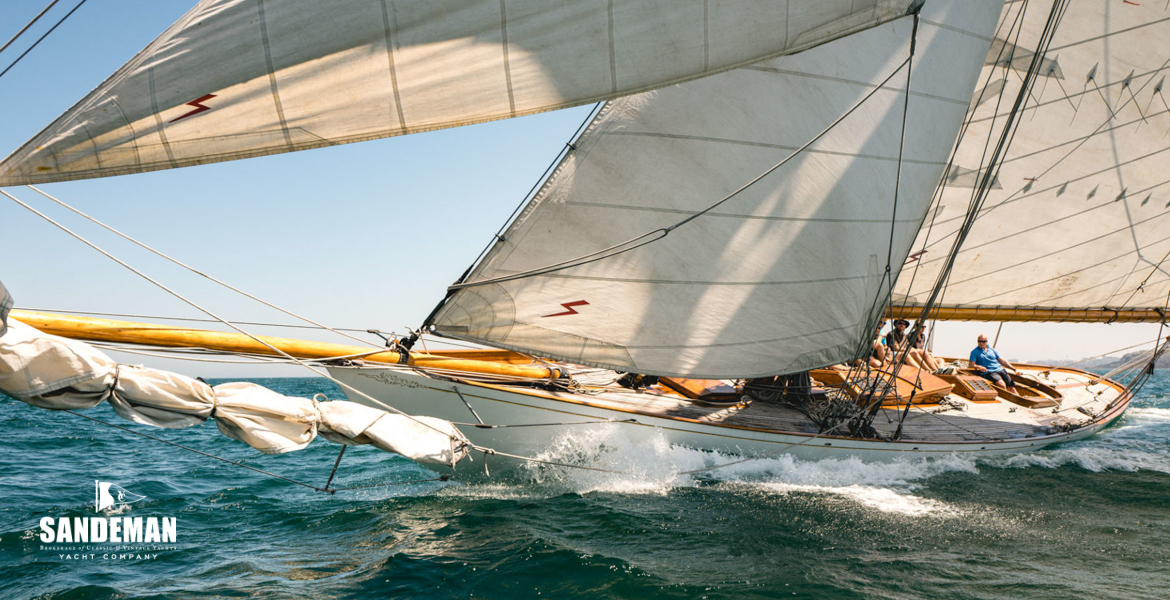
![Abeam Saint-Tropez 2016 [Photo: James Robinson Taylor]](https://images.sandemanyachtcompany.co.uk/uploads/boats/142x100_800_11284654296a857c5eb60c4.jpg)
![Cannes 2011 [Photo: James Robinson Taylor]](https://images.sandemanyachtcompany.co.uk/uploads/boats/142x100_800_18306073586a857c597ce56.jpg)
![Saint-Tropez 2016 [Photo: James Robinson Taylor]](https://images.sandemanyachtcompany.co.uk/uploads/boats/142x100_800_8181414316a857c5ced44c.jpg)
![Lee bow [Photo: lesrhabilleurs.com]](https://images.sandemanyachtcompany.co.uk/uploads/boats/142x100_800_9046574666a75d87008ef8.jpg)
![Cruising [Photo: lesrhabilleurs.com]](https://images.sandemanyachtcompany.co.uk/uploads/boats/142x100_800_3403501626a7743c051f8a.jpg)
![Port Quarter [Photo: lesrhabilleurs.com]](https://images.sandemanyachtcompany.co.uk/uploads/boats/142x100_800_866468266a7743c465ca8.jpg)
![Cannes 2011 [Photo: James Robinson Taylor]](https://images.sandemanyachtcompany.co.uk/uploads/boats/142x100_800_2483841746a857c5b6fcdf.jpg)
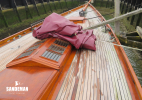
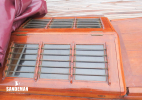
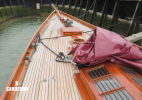
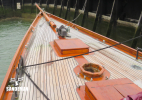
![Owner 1905 - c.1915 Commodore Charles H. Holland [Royal Burnham YC]](https://images.sandemanyachtcompany.co.uk/uploads/boats/142x100_800_10989196316a8320af9d068.jpg)
![Early 1900s [Royal Burnham YC]](https://images.sandemanyachtcompany.co.uk/uploads/boats/142x100_800_5004433096a834573f1a0c.jpg)
| Diseñador | William Fife III |
|---|---|
| Constructor | William Fife & Son, Fairlie |
| Fecha | 1897 |
| Eslora total | 74 ft 10 in / 22.8 m |
| Eslora en cubierta | 63 ft 2 in / 19.25 m |
| Eslora en línea de flotación | 44 ft 2 in / 13.47 m |
|---|---|
| Manga | 11 ft 7 in / 3.53 m |
| Calado | 8 ft 6 in / 2.6 m |
| Desplazamiento | 22 Tonnes |
| Construcción | Mahogany on elm, oak, and acacia |
| Motor | Solé 101 hp diesel engine |
|---|---|
| Ubicación | France |
| Precio | EUR 450,000 |
Estos detalles son provisionales y pueden ser modificados.
The William Fife sleeping beauty NAN OF FIFE, of course exquisite in form, and well proven on the race course – both in the Victorian and Edwardian golden era of yachting and through the early decades of the present Century – is something very special. As is the story of her discovery by the present owner and the inspiration he gained from that to give her back the kind of life she’d enjoyed in her prime. Here is a William Fife III jackyard topsail, fast cruiser-racer with all the grace, moderation, seakindliness and speed one expects, and at a very rare size: certainly not small, but not too big; handy enough to cruise with just a few friends; thrilling enough to race with just a few more; and of dimensions that can be easily transported by road for a change of sailing horizon. NAN OF FIFE ticks so many boxes and is available for the first time this century. NAN OF FIFE is a light sleeper - it shouldn't take much to wake her.
Interesado en NAN OF FIFE con más detalle.
Undertaken at owner's own shipyard near Saint-Malo
Following the original plan copies from Fairlie Restorations
Able to retain:
- The original wood keel
- The original saloon panelling and carpentry
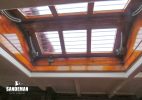
- The original teak butterfly skylights
Otherwise the hull and rig dates from 2000-2001
- Good CIM rating
- Details in 'CONSTRUCTION'
The saving and resurrection of this exquisite Fife ‘fast cruiser’ gaff cutter of an extremely rare size is a remarkable story of happenstance. The Rolex daily press reports from Les Voiles de Saint-Tropez 2011 tell it well:
“Some Fife-designed yachts exist today though some sort of divine serendipity – certainly that played a part in NAN OF FIFE’s survival… Philippe Menhinick already owned a classic yacht and wasn’t really looking for one. He recalled:
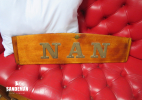
“ ‘I found Nan on the web, I was just looking on the net for nice boats and I saw this funny boat with an aluminium wheel, but all the details on deck. I wanted to see the boat in reality, so I went to see her in Cap d’Agde. Finally, I discovered the name, NAN, and remembered my grandfather had a boat called NAN. I discovered that it was my grandfather’s yacht, that he owned between 1948 and 1951 – I’d had no idea at all; it was destiny! My grandmother sold her engagement ring to pay the expenses on the yacht, but the boat was in really bad shape and my grandfather sold it to a Belgian guy from Ostend.’
“Forty-seven years later it was back in the family. Menhinick then spent 20 months restoring the yacht in a yard at Saint Malo, and finished in 2001, just in time to race in the Americas Cup Jubilee Regatta at Cowes.”
WILLIAM FIFE & SON YARD NO. 377
NAN’s story begins on Dublin Bay, Ireland, an (some would say THE) early hotbed of the sport of yacht racing as we know it today; where Thomas Cosby Burrowes of Lismore, Co. Cavan, was one of the keenest of amateur small boat helms; a dream client for yacht designers and builders because he kept on buying new boats. And his aquatic competitive streak wasn’t limited to sailing boats – he’d been an oarsman for the losing side, Oxford, in the 1879 Boat Race on the Thames.
Burrowes commissioned NAN from Fife in the summer of 1896. During her three months' build late that year, knowledgeable contemporary pundits considered her a Fife hull design sister somewhere between Peter Donaldson’s 1895 ISOLDE, a 40-Rater under the previous ‘Length and Sail Area Rule’ and Aemilius Jarvis’s 57 ft long CANADA of 1896, first winner that summer at Toledo, Ohio, of what became the Canada’s Cup. However, despite undoubted racing potential and her owner’s proficiency, NAN apparently never heard the starting gun until her second ownership on England’s Solent.
Although her build was more or less finished by December 1896, NAN wasn’t launched until the rising spring tides of the last week of April 1897. Her first skipper, Dan Murphy, took delivery and sailed her in May from the Clyde to Kingstown (now Dun Laoghaire).
The Yachtsman magazine’s Kingstown correspondent reported: “Mr. T. Cosby Burrowes’ cruising-cutter NAN arrived here on Thursday (20 May 1897) from Gourock in charge of Dan Murphy, who gives her abundance of praise. She looks both graceful and powerful, with plenty of beam, and thoroughly up-to-date. She is said, by the way, to resemble CANADA that won the Toledo Cup on the Great Lakes last year. Her topsides are a dark red.”
In July, he further reported: “Mr. T.C. Burrowes’ NAN left for the Clyde on Saturday (3 July 1897) merely as a cruiser, her owner does not intend to race her this season.”
Apart from reports of NAN later stationed at Skerries, Co. Dublin, and of a late 1897 season return passage to the Robertson yard at Sandbank, Firth of Clyde, for “alterations and improvements” by Fife’s carpenters, that’s the sum of our current knowledge of NAN in first ownership.
During winter 1898-1899 Fife built the Dublin Bay 25ft (waterline) Class boat NANCE for Burrowes (now still very much alive as IONA in the Mediterranean) and ownership in NAN transferred to London and St. Helens, Isle of Wight based gentleman of leisure with a legal training, Salusbury M. Mellor.
Customs records from the port of Glasgow (where NAN was registered from probably before launch until c.1918) reveal that Mellor had been NAN’s “Manager” from the start for Cosby Burrowes, the common bond probably being their forbears’ Madras, India colonial service connections.
Mellor was also a keen and able amateur sportsman in multiple fields. Having apparently never raced in first ownership, NAN hit the ground running in 1899, gaining an enviable reputation as a scratch boat that could take line honours and still save her time: “like a witch on a broomstick” one enthusiastic yachting journalist proclaimed.
She won her class in what is believed to be her debut regatta on Monday 5 June 1899: the Royal Thames Yacht Club’s “River Matches” on the Thames estuary. The general fleet included the magnificent G.L. Watson-designed schooner RAINBOW, the small Big Class cutter BONA, and most of the hottest mid-sized raters of the time. The Yachtsman reported: “NAN is a … very smart little cruiser, as the day proved, for she won easily enough without time allowance.” A week later she continued as she started with two class wins at Ramsgate regatta week.
On 31st June at the Royal London Yacht Clubs opening regatta of Cowes Week NAN was scratch boat in class and took line honours and 2nd on corrected time, and in August on her new home waters off Ryde she again took line honours during “Ryde Week”. The German Emperor’s METEOR II (G.L. Watson 1896) added to the Big Class spectacle at these events.
And more of the same in 1900, performing well early season on the Thames, winning her class in the Royal Thames Yacht Club’s Nore to Dover race, and winning prizes at various south east of England regattas. But there was to be no Cowes Week for NAN in 1900 for a very good reason.
She crossed the English Channel to participate in the 10-20 Tons (French Godinet Rule) division of the Paris Olympics yachting regatta at Le Havre. Generally, and not surprisingly, yachts built to rather than just rated by the rule dominated and NAN finished 5th. One of NAN’s future protagonists a century later at the Western Mediterranean classic regattas, BONA FIDE - a dedicated fin and bulb keel Godinet Rule boat designed and built by Charles Sibbick of Cowes - won the gold medal in the 5-20 tons category.
Excepting Olympic excitement, a pattern had been set for NAN’s next decade in the ownership of a further two exceptionally keen racing yachtsmen, based from the River Crouch, Essex but doing the established south, south east coast – including Belgian (Ostend) and French (Boulogne) – and English ‘West Country’ summer circuit of regattas.
Staying with Salusbury M. Mellor briefly: he died of natural causes in 1917 and in 1920 his widow, Daisy, became the second wife of yacht designer Alfred Westmacott (X-One Design; Solent Sunbeam, etc). The Mellors’ youngest son Alexander (“Alec”) eventually worked closely with Westmacott in managing St Helens Isle of Wight yacht builders Woodnutt & Co. Ltd., with Alec continuing the business after Westmacott’s death in 1936.
In March 1901 the Yachtsman’s River Crouch correspondent reported NAN’s sale to Geoffrey N.E. Hall-Say (lawyer; future Olympic figure skater) and Herbert M. Elder (physicist; Cambridge academic; leading light in the early years of Cambridge University Cruising Club), and her arrival at her new home port, Burnham-on-Couch, later that spring. But there was to be no change in her ambitious regatta programme. NAN continued to win and place well in the Essex, Thames and Kent regattas, regularly moored early and late summer off the short-lived new Royal Corinthian Yacht Club railhead clubhouse at Port Victoria, Isle of Grain, Kent – a site now completely overrun by the petro-chemical industry.
Late July 1901 saw NAN in Belgium attending Ostend International Regatta Week. In the feeder race from Dover, she sailed in company with the first ever Fife yacht to make its mark (and the Fife yard’s fame) on the south coast of England, FIONA (aka ‘The Fawn o’ Fairlie’), designed and built by William Fife Sr (‘II’) in 1865. Then Cowes week in August. A fascinating direct competitor at this time was the Herreshoff fin-keeled rater JAPONICA which had arrived in the UK in 1895 as Howard Gould’s NIAGARA, helmed in her first season by Charlie Barr’s half brother, John Barr.
1902
Essex and Kent regattas; July: Ostend International Regatta; August: Cowes Week, Weymouth, Torquay, Dartmouth, Plymouth; September: Port Victoria, Kent; Winter: laid up at Tollesbury.
1903
Essex and Kent regattas; July: Boulogne International Regatta; August: Ryde Week, the West Country.
1904
Probably not in commission?
In early 1905 NAN was purchased by fellow River Crouch-based racing yachtsman Charles H. Holland, from a successful family of Thames coal factors, collier ship owners and agents. Holland’s previous yacht had been the beautiful, clipper-bowed G.L. Watson/ Camper & Nicholsons cutter VALENTINE, previously one of NAN’s competitors in the handicap classes.
There was to be no let-up in NAN’s hunger for regattas in 1905: a similar circuit as 1902 and 1903 saw her gaining a class win at the RYS Cowes Week regatta. And if that wasn’t enough, in October Holland unshipped her racing gear, bent on her trysail and took her trawling until just before Christmas.
NAN’s 1906 racing season was to be the most intense yet, coinciding with her owner’s election as Commodore (1906-1911) of, later Royal, Burnham Yacht Club. Perhaps Holland was cramming his bucket list before fully taking up flag officer responsibilities.
After an easter cruise to from Burnham to Boulogne, NAN endured a rough May passage of 700 miles to the Firth of Clyde, including 48 hours hove-to. Shadowing the much larger yachts racing up to an earlier than usual Clyde Fortnight in the Royal London Yachts Club’s Cowes to Clyde Race for 100-tonners and over, she arrived in time to take two firsts and two seconds in the waters of her birth. Again, she rubbed shoulders with one of William Fife Sr (II)’s most famous creations, the old 40-Tonner BLOODHOUND, launched at Fairlie in 1874 for the Marquis of Ailsa.
Holland’s last racing season with NAN appears to have been 1907: perhaps not surprisingly, less intense than usual but still including Ramsgate and Ostende Weeks. He began to appear in results for small boat classes racing on the River Crouch, particularly a strong local class of ex 24 Linear Raters, and he became a keen motor boater. NAN may have been converted for a cruising/ houseboat role at Burnham, with a cut down rig. There is a tentative record of a 2-cylinder 7hp Kelvin petrol motor being installed in 1911. What is for sure is that she was never reported as racing again, most probably until her 2001 post re-build debut, at the Americas’s Cup Jubilee Regatta, Cowes.
Lloyd’s Register of Yachts (LRY) continued to list NAN in Holland’s name until the First World War; then the 1918 and 1919 editions state rather dramatically “Broken up”. Perhaps her lead ballast keel was removed and donated to the war effort, but her hull must have been saved, perhaps laid up in a Tollesbury mud berth, maybe as a houseboat.
Then in the 1926 edition of LRY (interestingly, the year Charles Holland died) NAN reappeared, rigged as an auxiliary ketch and owned by retired Royal Engineers Major Kenric J. McMullen who had settled with his family at Tollesbury post-war and eventually helped to found Tollesbury Sailing Club. McMullen restored her British Registration in 1935, her registered port moving from Glasgow to Colchester, and then sold her in 1938 to Hertfordshire estate agent Stephen Sparrow who sold her in 1947 to fellow Little Ship Club member Archie Douglas Marshall who sold her in 1948 George H. Menhinick of Hamble, Hampshire, by chance the present owner’s grandfather. NAN’s last publicly recorded 20th Century owner, one of the Zurstrassen industrialist family of Château du Joncmesni, Verviers, Belgium, purchased NAN from George Menhinick in 1951 and was last shown as owner by Lloyd’s Register of Yachts in 1958.
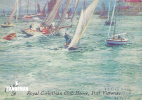
The remarkable story of the present owner stumbling upon his grandfather’s NAN is told above. Since her 2001 restoration/ rebuild, she’s been a well-known attendee and winner at the Mediterranean classic regattas, including at Cannes Régates Royales and Les Voiles de Saint-Tropez, and has cruised gently in Brittany.
©2026 Iain McAllister/ Sandeman Yacht Company Ltd.
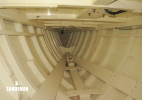
- Mahogany planking
- stainless steel screw fastened to sawn oak frames
- 2 x Steamed acacia timbers copper riveted between frames
- Full length bilge stringers
- Additional, futtock-like doubler frames in way of mast
- Original elm wood keel
- Lead keel ballast keel cast 2001 to Fife drawings
- Stainless steel keel bolts (2001)
- Galvanised steel floors; stainless steel fastened
- Oak deck structure
- Marine plywood subdeck
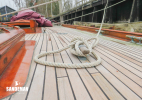
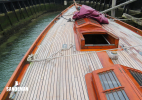
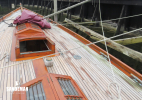
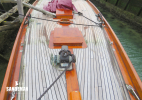
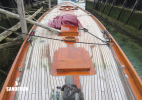
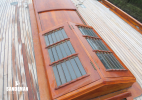
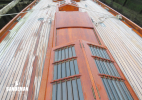
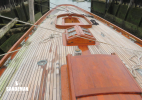
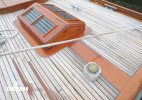
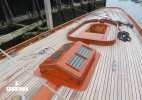
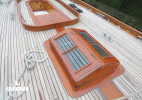
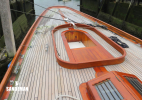
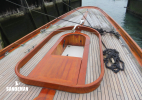
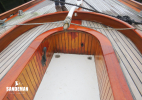
- Oregon pine laid deck
GENERAL
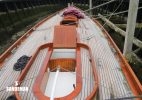
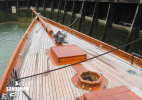
- Oregon pine laid deck on marine plywood substrate
- Teak and mahogany superstructures
FROM AFT
- Anti chafe strips at taffrail
- Bronze mooring bollard on centreline
- Mainsheet purchase padeyes
- Bronze rudder head
- Believed original solid steel tiller
- Bronze mushroom vents port & starboard
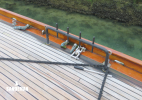
- Cleats and running backstay fittings at side decks
COCKPIT
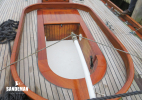
- Well type; deck as seating port & starboard
- Raised coaming
- Sheet cleats port & starboard
- Locker forward
- Throttle control
MID DECK
- Raised bronze mushroom vent
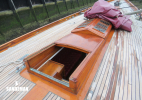
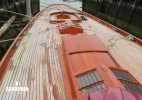
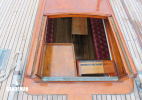
- Butterfly skylight over owner cabin
- Sheet cleats port & starboard
- Companionway hatch and skylight over saloon
- Hatch over galley
- Nun's cape fairleads and cleats port & starboard
MAST POSITION
- Bronze pinrails outboard at chainplates
FOREDECK
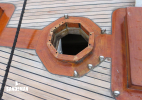
- Raised forehatch over fo'c'sle
- Nun's cape fairleads port & starboard
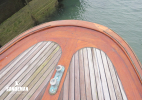
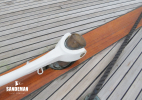
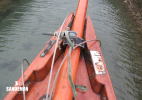
- Lofrans type windlass
- Bronze chain gipsy to starboard
- Bronze warping drum to port
- 50 m Galvanised anchor chain
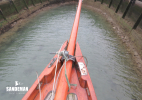
- Stainless steel bowsprit heel, gammon iron and cranse
- Mooring fairlead to port of stemhead
- Anchor roller removable fitting to starboard of stemhead
GENERAL
- Simple layout as it would have been originally
- Minimal systems
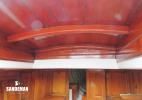
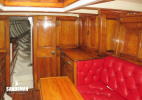
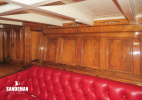
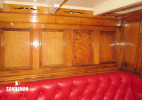
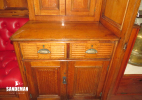
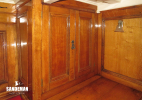
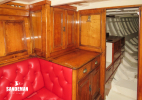
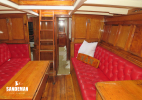
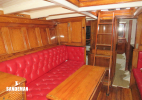
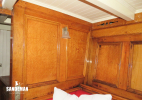
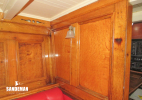
- Original saloon carpentry and panelling in oak
DOWN 6 x STEPS TO SALOON
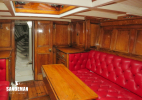
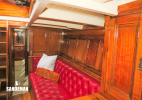
"When sitting in the saloon on the beautiful leather Chesterfield you are sitting in a room of history of the 19th century!"
- Original oak panelling and carpentry
- Button leather upholstered settees to port and starboard
- Drop leaf saloon table
- Butterfly skylight over
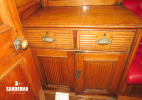
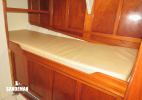
- Sideboards forward to port and starboard
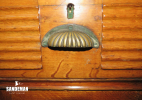
- Drawers and lockers under
- Lockers outboard
- 4 x Bulkhead lamps; frosted glass shades
BULKHEAD DOOR OFFSET TO PORT TO PASSAGE FORWARD
- Hatch in deckhead
To Port
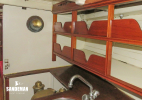
GALLEY
- Space for gimballed cooker
- Work surface with lockers under
- Inset stainless steel sink
- Mixer tap
- Plate racks
- Bulkhead light
To Starboard
WC COMPARTMENT
- Jabsco manual sea toilet
SKIPPER's CABIN TO STARBOARD OF MAST
- Single berth
- Stowage outboard and over
FO'C'SLE
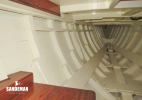
- Unfitted (light ends for good racing trim)
- Used for sail and lines stowage
- Raised forehatch in deckhead
AFT OF COMPANIONWAY
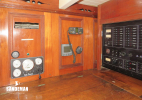
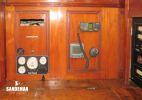
CHART TABLE TO STARBOARD
- Ratheon data repeater
- VHF Radio
- Solé diesel panel
- Ship's electrical panel
- Bulkhead lamp; frosted glass shade
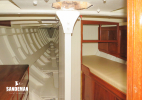
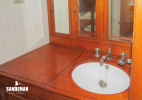
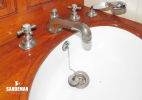
PASSAGE BATHROOM TO PORT
- Inset ceramic sink; taps; shower head
- Lockers outboard and under
- Bulkhead lamp; frosted glass shade
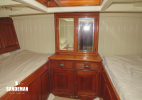
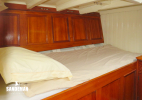
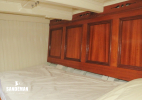
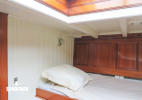
OWNER CABIN AFT
- Carpentry and panelling in oak
- Generous single berths port and starboard
- Dressing table aft with drawers and lockers
- Mirror door lockers aft
- Butterfly skylight over
- 2 x Bulkhead lamps; frosted glass shades
RIG
- Spars of spruce and Oregon pine
- Standing rigging new in 2018
SAILS
Dacron by Victor Tonnere (2001)
- Mainsail
- Jib headed topsail
- Jackyard topsail
- Staysail
- Jib
- Jib (Incidence c.2016)
- Asymmetric downwind sail
CANVASWORK
- Vinyl winter cover for superstructures
MECHANICAL
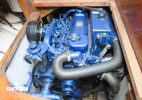
- Solé 101 hp diesel engine (2013)
- c.500 hours
- Stainless steel propeller shaft offset to starboard
- Folding propeller
ELECTRICAL
- A simple DC system for
- lighting
- pressurised hot water
- engine start
- Charging by engine alternator and shore power unit
TANKAGE
- Custom stainless steel diesel fuel tank c.80 L / c.18 Gal
- 1 x Hot water tank at WC Compartment (calorifier and electric)
- (No fresh water tank)
NAVIGATION
- Steering compass in brass binnacle
- Ratheon MFD at chart table
COMMUNICATIONS
- VHF Radio at chart table
- Life jackets
- Fenders
- Mooring lines
- Passarelle plank
Sailing: lesrhabilleurs.com
Contáctenos para hablar sobre NAN OF FIFE con más detalle.
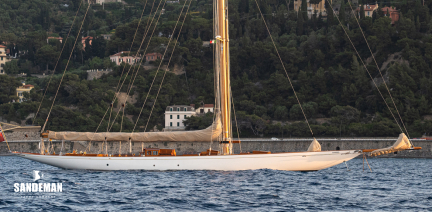
| Nombre | CAMBRIA |
|---|---|
| Diseñador | William Fife III |
| Constructor | William Fife & Son, Fairlie |
| Fecha | 1928 |
| Eslora en cubierta | 111 ft 0 in / 33.83 m |
| Manga | 20 ft 7 in / 6.28 m |
| Calado | 13 ft 9 in / 4.2 m |
| Desplazamiento | 120 Tons |
| Arqueo bruto | 68 Tons |
| Ubicación | France |
| Precio | EUR 7,000,000 |
| IVA | VAT Not Paid |
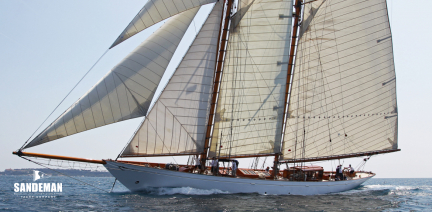
| Nombre | ALTAIR |
|---|---|
| Diseñador | William Fife III |
| Constructor | William Fife & Son, Fairlie |
| Fecha | 1931 |
| Eslora en cubierta | 107 ft 7 in / 32.8 m |
| Manga | 20 ft 6 in / 6.25 m |
| Calado | 13 ft 9 in / 4.2 m |
| Desplazamiento | 155 Tons |
| Ubicación | Spain |
| Precio | EUR 6,500,000 |
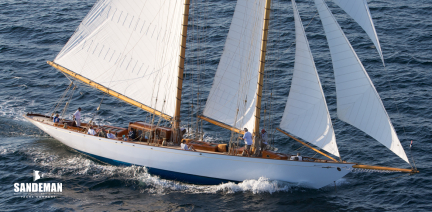
| Nombre | ADVENTURESS |
|---|---|
| Diseñador | William Fife III |
| Constructor | William Fife & Son, Fairlie |
| Fecha | 1924 |
| Eslora en cubierta | 82 ft 0 in / 25 m |
| Manga | 17 ft 1 in / 5.2 m |
| Calado | 9 ft 8 in / 2.95 m |
| Desplazamiento | 61.6 Tons |
| Ubicación | Caribbean |
| Precio | USD 2,200,000 |
| IVA | VAT Not Paid |
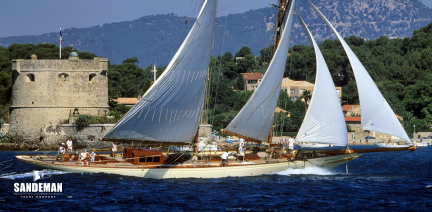
| Nombre | SUNSHINE |
|---|---|
| Diseñador | William Fife III |
| Constructor | Myanmar Shipyards |
| Fecha | 2003 |
| Eslora en cubierta | 101 ft 8 in / 31 m |
| Manga | 18 ft 4 in / 5.6 m |
| Calado | 11 ft 2 in / 3.4 m |
| Desplazamiento | 80 Tons |
| Ubicación | Spain |
| Precio | EUR 1,900,000 |
| IVA | VAT Not Paid |
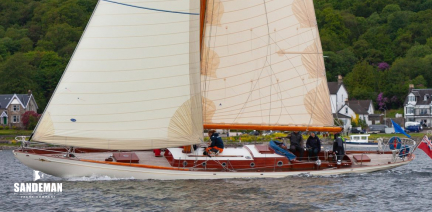
| Nombre | SIBYL OF CUMAE |
|---|---|
| Diseñador | William Fife III |
| Constructor | William Fife & Son, Fairlie |
| Fecha | 1902 |
| Eslora en cubierta | 51 ft 7 in / 15.72 m |
| Manga | 8 ft 8 in / 2.64 m |
| Calado | 6 ft 7 in / 2.01 m |
| Desplazamiento | 11 Tons |
| Ubicación | United Kingdom |
| Precio | GBP 235,000 |
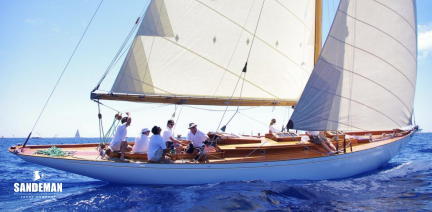
| Nombre | SOLWAY MAID |
|---|---|
| Diseñador | William Fife III |
| Constructor | William Fife & Son, Fairlie |
| Fecha | 1940 |
| Eslora en cubierta | 52 ft 1 in / 15.87 m |
| Manga | 10 ft 10 in / 3.3 m |
| Calado | 7 ft 6 in / 2.29 m |
| Desplazamiento | 15.5 Tons |
| Ubicación | France |
| Precio | GBP 225,000 |
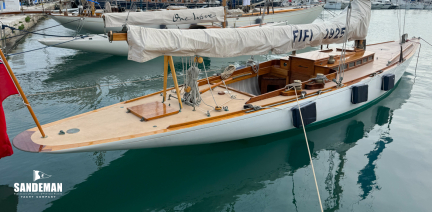
| Nombre | FIFI |
|---|---|
| Diseñador | William Fife III |
| Constructor | Henry B. Nevins, City Island, New York |
| Fecha | 1925 |
| Eslora en cubierta | 39 ft 8 in / 12.1 m |
| Manga | 7 ft 3 in / 2.2 m |
| Calado | 5 ft 9 in / 1.75 m |
| Desplazamiento | 5.9 Tons |
| Ubicación | Italy |
| Precio | USD 190,000 |
Estos detalles se han preparado a partir de la información proporcionada por los vendedores y tienen carácter de guía general. El comprador debe confirmar los detalles que le preocupen mediante inspección o peritaje. El comprador también debe asegurarse de que el contrato de compra refleje correctamente sus inquietudes y especifique los detalles en los que desea confiar.
